
Sketches of future digital services in government
Throughout 2019 and early 2020, I was leading a team looking at personalisation and what that might mean for users of digital public services. Over the 14-month period, we explored a lot of avenues, some times finding dead-ends, but often finding more pathways to unexplored territories.
We were grounded by a definition of personalisation that was appropriate for digital public services: We’re not trying to increase clicks or engagement, we’re interested in minimising the administrative burden of services so that people can get on with their lives. We wanted to join the dots between whole services that span multiple departments, yet expose the seams to maintain trust.
Depending on the domain of a service, this felt too frictionless occasionally. We knew there were moments in people’s lives when you deserved the full support of government, and there were moments in services when friction was helpful. So it wasn’t a perfect definition but it was more appropriate than the prevailing definition from the private sector.
We created a heck of a lot of sketches, wireframes and janky prototypes. The half-life of these artefacts was short; they were used to advance or realise our thinking. We had a few rounds of user research in which we were able to test out our ideas and iterate the vision. But the pandemic arrived just as we were getting into the swing of things and we paused the work.
I want to share some of the early sketches, just to put them out in the open. They paint a picture of a possible future. The sketches show a paradigm shift from linear, unidirectional services to a more dynamic, relational future.
Sketches
It’s important to caveat that these weren’t tested, they are visions, and they’re riddled with assumptions. If you poke them, you will find holes.
The sketches were made in the paradigm that existed at the time: the web as the only digital channel and data stored by services. A cross-government account was added. We explored other possibilities later, like personal data stores and mobile devices, but I didn’t keep the material.
The underlying infrastructure – both technical, political and ethical – required to make these work is not insignificant. (And it’s not the type of work that AI can help you with.)
We explored some of that underlying infrastructure but the task was larger than one team could achieve.
Contextual recommendations
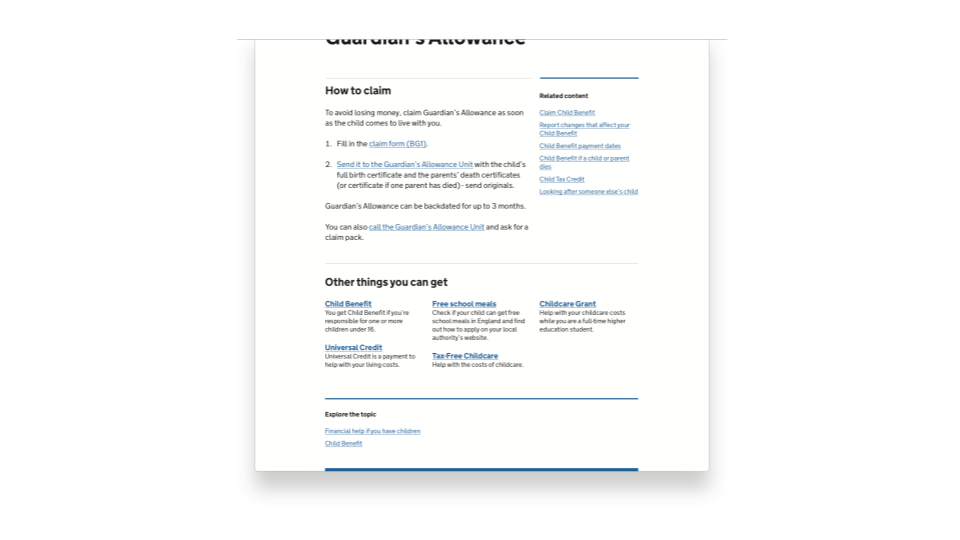
These recommendations were fairly basic. You don’t need to know anything about the person using the service, these recommendations can be curated, domain-driven and based on taxonomies. If someone is claiming a benefit, there are likely other benefits that they’re entitled to.
Use saved information
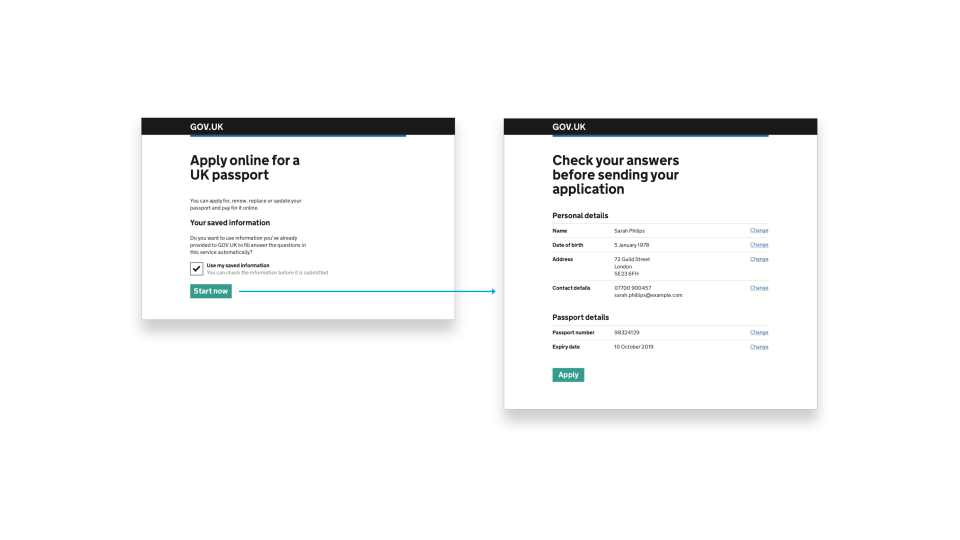
Playing on the ‘once-only’ legislation in Estonia, this sketch showed how users might be able to re-use information they’ve already shared with government, to save them retyping the information. We looked at privacy-protecting technologies that might enable this and how it might be achieved without a register of people, as per the Identity Documents Act.
Tell us once only
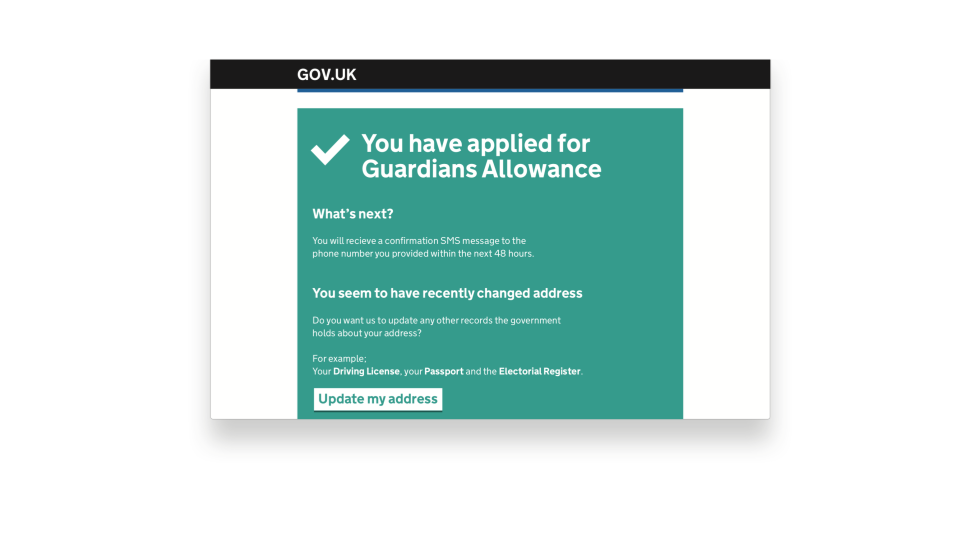
Another one playing on the ‘once-only’ legislation in Estonia. Stored details could be updated if the system recognised that the details had changed, saving the user having to retype these. It’s a pattern that could work for a personal data store too.
Eligibility-based recommendations
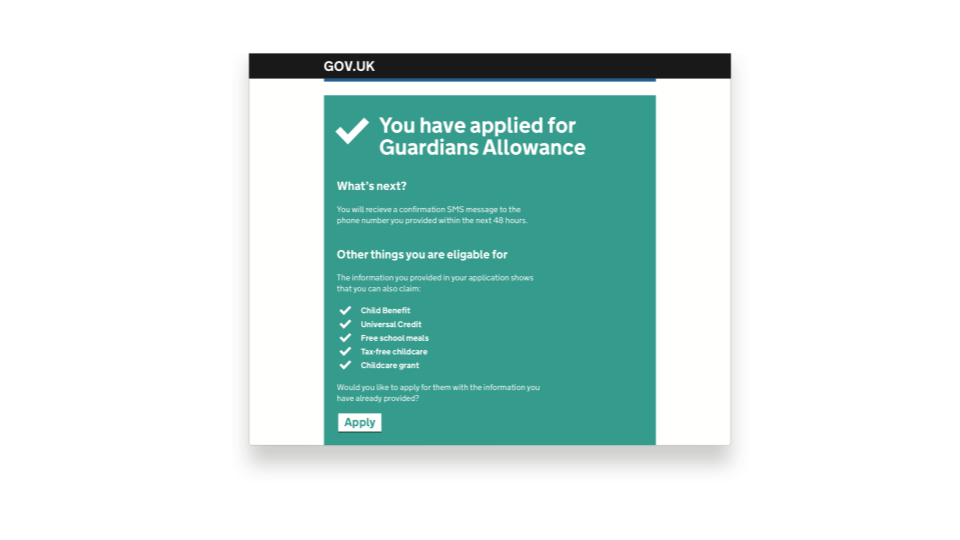
The concept of eligibility loomed large. This sketch illustrated how there may be joins between existing policies and services. By checking the information a user provides through a service, other services they’d be eligible to use could be recommended.
Whole services
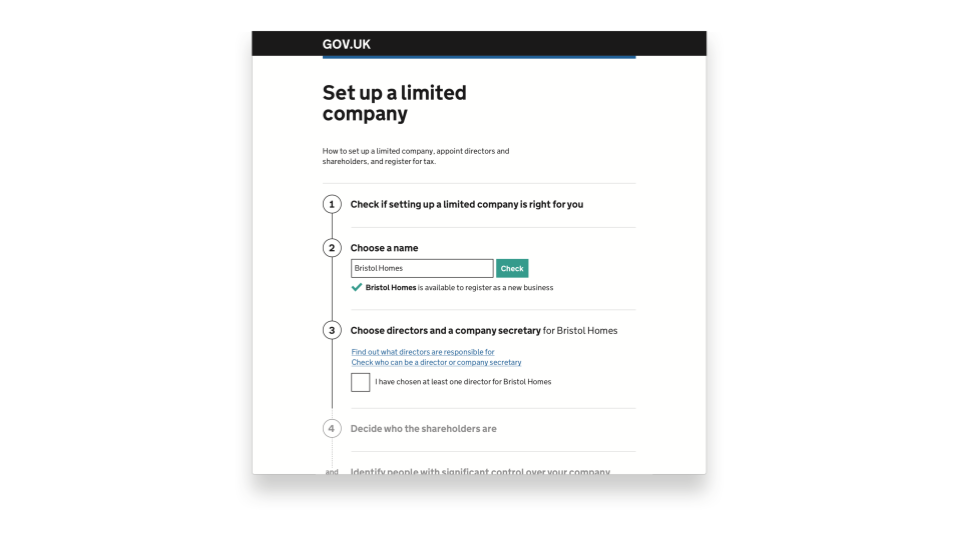
This sketch illustrated a compound or whole service. It joins together services provided by two or more organisations into one flow, utilising APIs.
Account settings
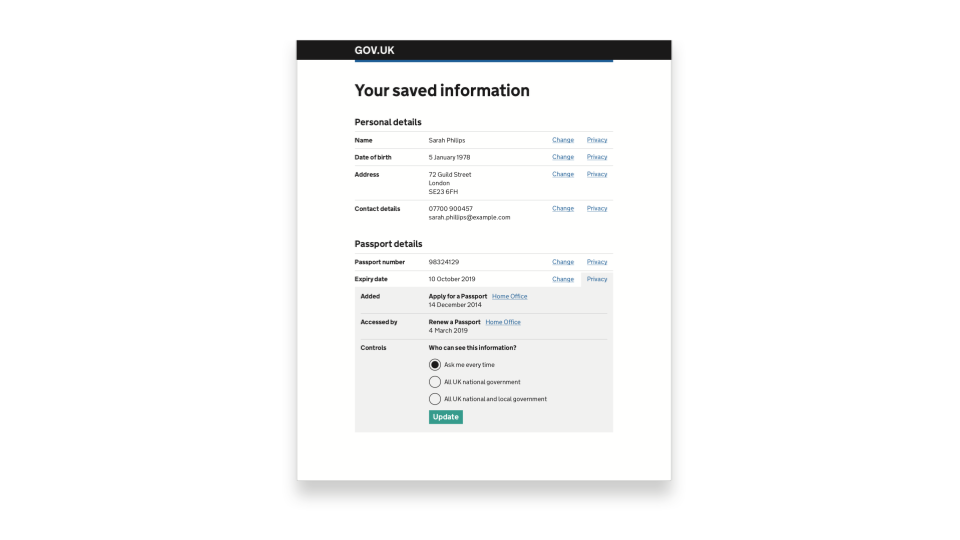
Account settings give users control. This sketch shows choices a user can make about how their information is used. It raised questions of equitability, for example, is it right for some people to receive ‘better’ services than others?
Notifications
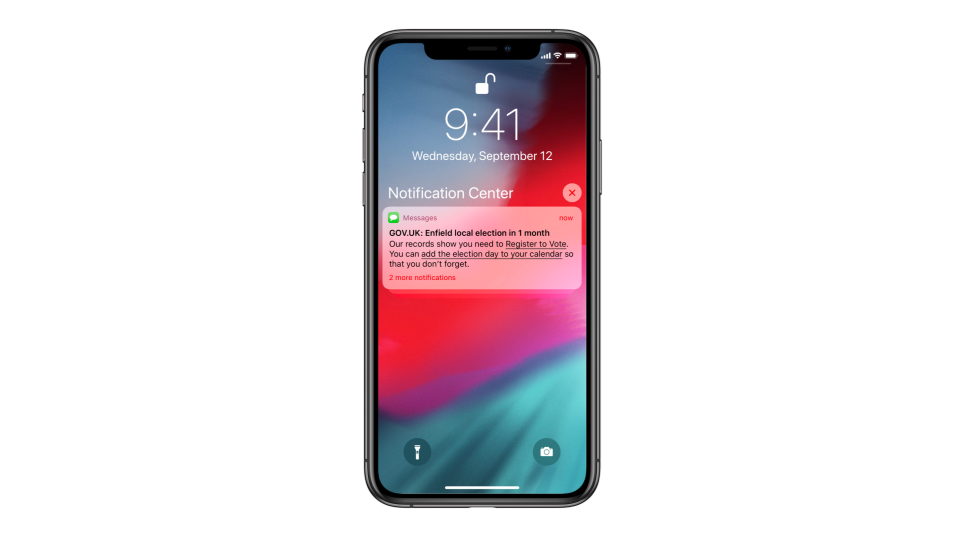
The onus is on the user to find, do and remember things, but notifications could make services more proactive and responsive. Push notifications reach into a user’s personal space, however, and should be used sparingly.
Reminder
It’s important to remember that these weren’t tested, they are visions, and they’re riddled with assumptions. These sketches were the output of three months of interviews and desk research, four or five workshops, and an afternoon of wireframing.
If you poke them, you will find holes.
Credits: Content strategy: Paola Roccuzzo. Design: Mark Hurrell, Kate Ivey-Williams and Mia Allers. Technology: Tim Blair. Policy: Tom Moore.